Have you ever asked Siri or Google Assistant a question and got an answer instantly? Or maybe Netflix suggested a show that you actually ended up loving? Or your phone’s camera automatically knew there was a face in the photo and focused on it?
All of that is Artificial Intelligence, or AI, working quietly in the background.
If you’ve heard the term “AI” everywhere lately and felt a little confused about what it actually means, don’t worry. You’re not alone. In this guide, I’ll explain AI the way I’d explain it to a friend over coffee — no confusing jargon, no scary robot movies, just simple, clear ideas.
Let’s get started.
So, What Exactly is Artificial Intelligence?
In the simplest words possible:
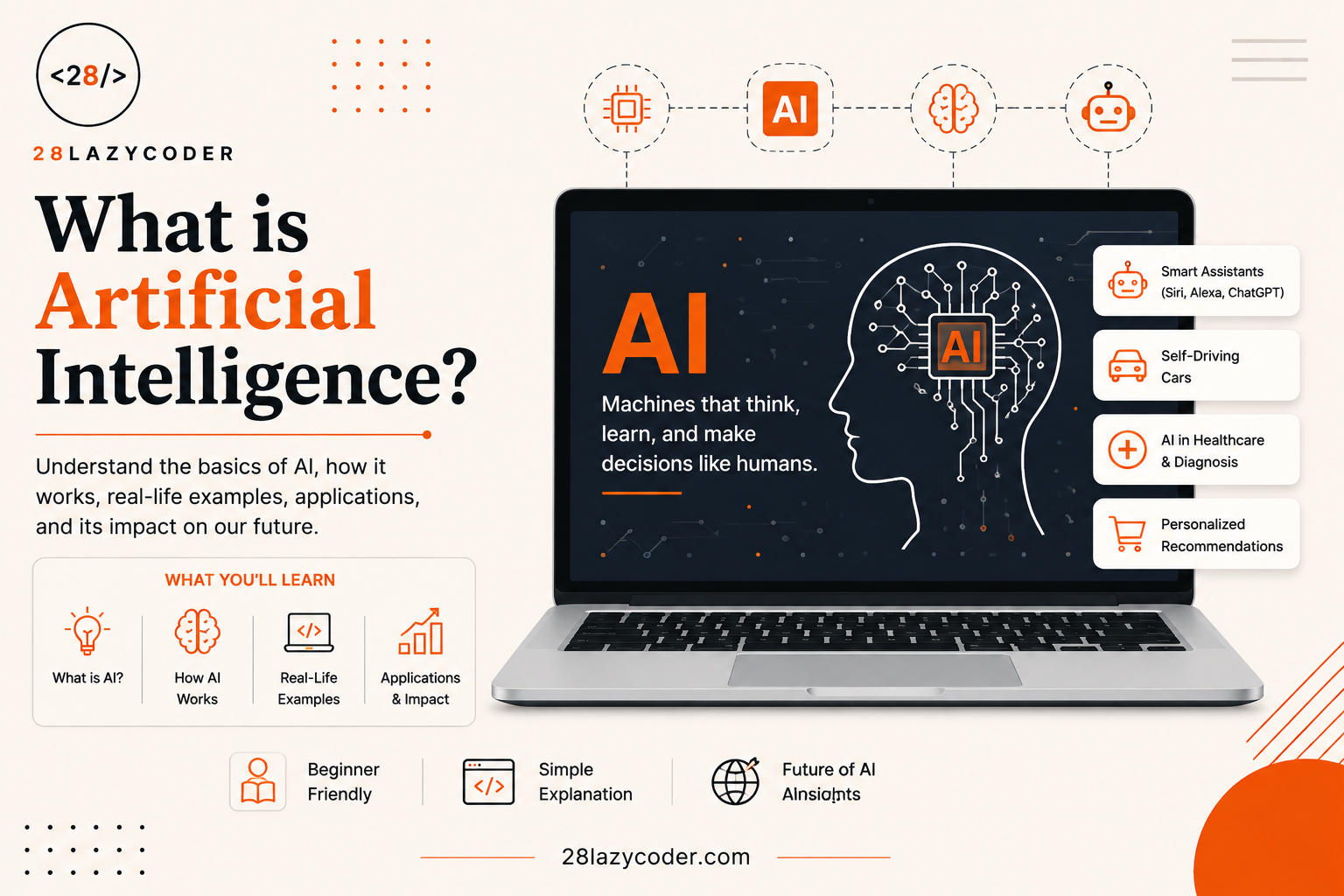
Artificial Intelligence is the ability of a computer or machine to do things that normally need human thinking — like recognizing pictures, understanding language, making decisions, or solving problems.
Think about how your brain works. When you see a photo of a dog, you instantly know it’s a dog. You didn’t have to think hard about it — you just knew. That’s because your brain has learned, over your whole life, what a dog looks like.
AI tries to do something similar, but with a computer. We “teach” a computer using lots of examples (like thousands of dog photos), and over time, it learns to recognize a dog on its own, without a human telling it every single time.
That’s the heart of Artificial Intelligence: making machines “smart” enough to do tasks that usually need human intelligence.
Wait, Is AI the Same as a Robot?
This is one of the most common mix-ups, so let’s clear it up right away.
- A robot is a physical machine — it has a body, and it can move, pick things up, or walk.
- AI is the “brain” or the software that helps a machine (or even just a computer program, with no physical body at all) make smart decisions.
So a robot can have AI inside it to help it “think,” but AI doesn’t need a robot body at all. For example, the AI that suggests videos on YouTube isn’t a robot — it’s just smart software running on a server somewhere.
In short: AI is the brain. A robot is one possible body it could live in — but most AI today doesn’t have a body at all.
How Does AI Actually “Learn”?
Here’s where it gets interesting. AI doesn’t learn the same way humans do (it doesn’t get bored in school or forget things overnight). Instead, most modern AI learns through something called Machine Learning.
Machine Learning (ML) is simply a way of teaching computers to learn from data (examples) instead of being told exact instructions for every single situation.
Here’s a simple example:
Imagine you want to teach a computer to tell the difference between a cat and a dog.
- Old way (traditional programming): You’d have to write very specific rules like “if it has pointy ears and whiskers, it’s a cat.” But animals don’t always follow neat rules — this gets messy fast.
- AI/Machine Learning way: You show the computer thousands of labeled cat and dog photos. The computer studies the patterns on its own (like ear shapes, fur patterns, sizes) and gradually learns to tell them apart — without you writing exact rules.
The more good-quality examples (data) you give it, the better it usually gets. That’s why you’ll often hear people say “data is the fuel for AI.”
Related read on 28LazyCoder: If you want to go deeper into how machines learn from data, check out our other beginner-friendly articles at 28LazyCoder.
The Different “Levels” of AI (Explained Simply)
Not all AI is the same. Some AI is very basic, and some is incredibly advanced. Here’s a simple way to think about the three levels experts usually talk about:
1. Narrow AI (also called “Weak AI”) This is AI that is really good at ONE specific job, but can’t do anything outside of that.
Example: A chess-playing AI can beat world champions at chess, but if you ask it to cook a meal, it has no idea what to do. Almost every AI you use today — voice assistants, spam filters, recommendation systems — is Narrow AI.
2. General AI (also called “Strong AI”) This would be AI that can think and understand like a human, across ANY topic — learning new skills the way a person can, not just one narrow task.
This does not exist yet. It’s still mostly a research goal and a popular topic in science fiction movies.
3. Super AI This is a hypothetical future AI that could be smarter than humans in every way. This is purely theoretical right now — nobody has built anything close to this, and it stays mostly in the world of research discussions and imagination.
The key takeaway: Every single AI tool you use today — ChatGPT, Google Assistant, Netflix recommendations — is Narrow AI. It’s powerful, but it’s still specialized, not a “thinking human-like brain.”
Where Do You Actually See AI in Real Life?
You probably use AI every single day without even noticing. Here are some everyday examples:
- Voice assistants — Siri, Alexa, and Google Assistant understanding your voice and replying
- Spam filters — Your email automatically sorting out junk mail
- Recommendation systems — Netflix, YouTube, and Spotify suggesting content you might like
- Face unlock — Your phone recognizing your face to unlock itself
- Maps and navigation — Google Maps predicting the fastest route based on traffic
- Chatbots — Customer support chats that answer your questions instantly
- Autocorrect and predictive text — Your keyboard guessing the next word you’ll type
None of this feels like “sci-fi robot AI,” right? That’s exactly the point — AI today is mostly quiet, helpful software working behind the scenes.
AI vs Machine Learning vs Deep Learning — What’s the Difference?
This trips up a lot of beginners, so here’s a simple way to remember it. Think of it like nested boxes, one inside another:
- Artificial Intelligence (AI) — the big, broad idea of making machines act smart. This is the biggest box.
- Machine Learning (ML) — a way of achieving AI, by teaching machines using data instead of fixed rules. This box sits inside the AI box.
- Deep Learning — a more advanced type of Machine Learning that uses something called a neural network (a system loosely inspired by how neurons in the human brain connect with each other) to handle very complex tasks like recognizing speech or generating images. This box sits inside the Machine Learning box.
So, all Deep Learning is Machine Learning, and all Machine Learning is AI — but not all AI is Machine Learning (some older AI systems just followed fixed, hand-written rules instead of learning from data).
Is AI Dangerous? Should I Be Worried?
This is a fair question, and honestly, a lot of smart people are discussing it right now, including researchers at companies like Google AI and OpenAI.
Here’s the honest, balanced answer:
- Today’s AI (Narrow AI) is a tool. Like any tool — a knife, a car, electricity — it can be used well or misused. It doesn’t have its own desires or intentions.
- The real concerns experts talk about are things like: AI making biased decisions if it’s trained on unfair data, AI being misused to spread false information, or AI taking over certain jobs.
- The “robots taking over the world” idea is mostly science fiction — that would require General AI or Super AI, which, as we covered above, doesn’t exist yet.
The responsible approach (which companies like Google, Microsoft, and OpenAI actively research) is building AI carefully, testing it for safety, and being transparent about its limits. It’s less “scary robot” and more “powerful tool that needs thoughtful rules.”
How Can a Complete Beginner Start Learning AI?
If this article got you curious and you want to go further, here’s a simple beginner roadmap:
- Understand the basics of programming — Python is the most popular language for AI, and it’s very beginner-friendly.
- Learn the fundamentals of Machine Learning — Google’s free Machine Learning Crash Course is a great, trusted starting point.
- Explore free official resources — Microsoft Learn AI has beginner modules that explain AI concepts step-by-step with hands-on practice.
- Play with real AI tools — Try ChatGPT or Google’s AI tools yourself. Ask questions, see how they respond, and get a feel for what AI can (and can’t) do.
- Keep learning consistently — AI is evolving fast. Following trusted sources and beginner blogs (like this one!) helps you stay updated without feeling overwhelmed.
You don’t need to be a math genius or a coding expert to start understanding AI. You just need curiosity and consistency.
Conclusion
Artificial Intelligence isn’t some scary, futuristic robot concept — it’s already a normal part of your everyday life, quietly helping you unlock your phone, find your way home, and pick your next favorite show. At its core, AI is simply about teaching machines to learn from examples and make smart decisions, just like how you learned to recognize a dog after seeing enough dogs.
The AI we use today is “Narrow AI” — really good at specific tasks, but nowhere close to human-level thinking. And that’s okay! Understanding this one idea alone will help you separate real AI news from movie-style hype.
If you’re excited to learn more, take it one small step at a time. Explore trusted resources, try out AI tools yourself, and keep following simple, beginner-friendly guides like this one. You’ve already taken the first step just by reading this far — well done!
FAQs
Q1. What is Artificial Intelligence in simple words? Artificial Intelligence is when a computer or machine is made to do tasks that usually need human thinking, like recognizing images, understanding language, or making decisions.
Q2. Is AI the same as Machine Learning? Not exactly. Machine Learning is one way of building AI, where a computer learns from data instead of following fixed rules. AI is the bigger idea; Machine Learning is one method used to achieve it.
Q3. Can AI think like a human? No, not yet. Today’s AI is called “Narrow AI,” meaning it’s good at specific tasks only. AI that can think and learn like a human across all topics (called “General AI”) doesn’t exist yet.
Q4. What are some everyday examples of AI? Voice assistants like Siri and Alexa, Netflix and YouTube recommendations, spam filters in email, face unlock on phones, and Google Maps traffic predictions are all common examples of AI in daily life.
Q5. Is AI dangerous? Today’s AI is a tool, not a decision-making being with its own intentions. Like any powerful tool, it needs to be used responsibly. Companies and researchers actively work on making AI safer and fairer.
Q6. How can a complete beginner start learning AI? Start by learning basic programming (Python is great for beginners), then explore trusted free resources like Google’s Machine Learning Crash Course or Microsoft Learn AI, and try using real AI tools to see how they work.
Continue Learning
Want to keep exploring AI in simple, beginner-friendly language? Check out more guides on 28LazyCoder.
For deeper, official learning resources, these are trusted and beginner-safe: